Column · @jaidenbksb143
Peptide Purity Decision Innovative Peptides-peptide Drug Exploration
Peptide Testing: Hplc & Mass Spec Pureness Overview Pinnacle
In conclusion, comprehending peptide pureness degrees and grades assists you make notified choices for your experiments. A peptide's purity percentage informs you just how much of that sample is the real offer versus byproducts, with typical research grades being around 95% as much as 98-99% for extra pureness. Analytical HPLC KPV and MS are your pals below-- HPLC measures purity, and MS validates identity, together guaranteeing you recognize what remains in your tube.A functional assay gauging downstream signaling-- or an architectural research utilizing NMR or X-ray crystallography-- requires the greatest purity available. Crystallographers in particular usually call for ≥ 98% purity since also minor pollutants can prevent crystal development or present condition into the crystal lattice. As particles exit the column, they travel through a detector-- normally a UV detector readied to 214 or 220 nm, wavelengths where the peptide bond soaks up light highly. The detector records how much UV light is taken in in time, producing a graph called a chromatogram. This overview breaks down what purity really means in peptide chemistry, exactly how it's determined, what the contaminations are, and just how to review the documents that shows a peptide is what it asserts to be.
An approved laboratory complies with stringent guidelines for examination accuracy and method validation. You can commonly inspect if a lab is recognized by means of its web site or paperwork; certification makes sure the lab's procedures and outcomes are held to global criteria. With high degrees of experience in carbohydrate chemistry and our comprehensive peptide evaluation system, Creative Peptides can provide high-grade peptide pureness resolution services. According to stringent evaluation quality control and biosynthetic quality assurance criteria, each peptide is strictly checked throughout the evaluation cycle.
Peptide Pureness And Precision: Just How Laboratories Verify Make-up
This degree of comprehensive evaluation makes sure the peptide's accuracy-- suggesting the sequence and purity are precisely as labeled-- which is important for speculative reproducibility. By confirming structure via several verified methods, lab validation assurances that scientists get a high-purity peptide that will certainly perform as anticipated in the lab. Laboratory validation of peptides is not only a clinical ideal practice-- it's typically a regulatory requirement when peptides are utilized in therapeutic development or professional research study.- Evaluating allows researchers to recognize exactly what's in the vial, validating both identity and high quality.
- If you've ever acquired a synthetic peptide for a lab experiment, you've likely observed a purity portion on the certification of analysis-- generally values like 95%, 98%, and even 99%.
- Making sure that each batch goes through proper lab screening helps validate the peptide's credibility and purity, which is vital for both research study validity and safety and security.
- Not every application needs 99% purity, and purification is a significant component of peptide production price.
The majority of peptide providers and study labs count on several reputable analytical approaches. All products are sold for research, research laboratory, or logical objectives just, and are not for human use. Product summaries and classifications do not imply any kind of therapeutic outcomes. At Chameleon Peptides, every product ships with detailed third-party screening paperwork. You can learn more about our analytical testing methods on our testing and top quality page. A 2016 study published in Nature discovered that more than 70% of scientists had tried and stopped working to reproduce an additional researcher's experiments.
Just How To Check Out Peptide Testing Outcomes
We use GC-MS, ICP-MS, and various other techniques to spot pollutants, guaranteeing product safety and regulative conformity. Peptide sequencing is important for recognizing the specific amino acid series of peptides, including alterations like phosphorylation or acetylation. Sequencing enables scientists to recognize the biological function of the peptide and its communication with various other molecules, assisting in the layout of useful peptides for varied applications. The peptide sample is dissolved in a suitable solvent and loaded right into an autosampler.
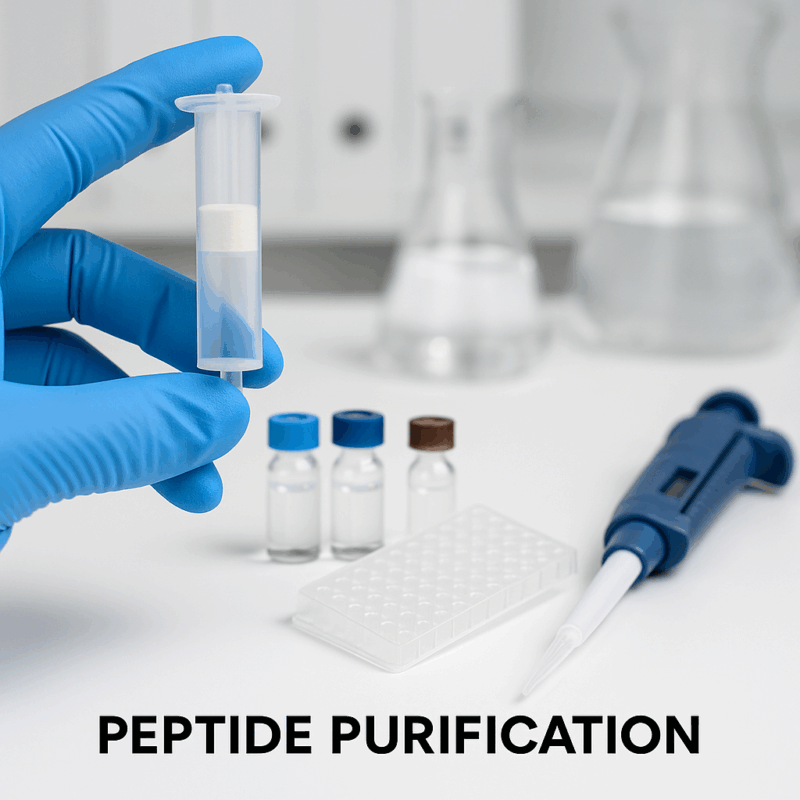
What Does Hplc-tested Mean?
By insisting on peptides that feature verification of purity and identification, researchers can substantially decrease the threat of speculative artefacts. On the other hand, utilizing peptides that have passed third-party lab recognition aids guarantee that the observed speculative effects are absolutely because of the designated peptide and not because of impurities or mistakes. When you see peptides promoted as "research-grade," it describes their meant use and the level of producing oversight. Research-grade peptides are produced lab study use only-- they are not generated under pharmaceutical GMP requirements and are not implied for use as rehabs or in human beings. These peptides feature a basic quality assurance package, typically consisting of HPLC pureness evaluation and MS verification of identity, ensuring they satisfy clinical requirements for purity and composition.